

MSc in Artificial Intelligence
Advance your knowledge of computer science and artificial intelligence and its applications, from machine learning foundations through to applied AI, natural language processing and the responsible use of AI.
- Credits
- 90 ECTS
- Duration
- 18–24 months part-time
- Delivery
- Fully online, cohort-based
- Award
- MSc in Artificial Intelligence
- Starts
- Monthly
- Entry
- EQF 6 degree or equivalent
Course Overview
The MSc in Artificial Intelligence is a 90 ECTS programme at EQF Level 7, made up of seventeen modules across three tiers. Tiers 1 and 2 build the programming, statistical and mathematical foundations and cover the core AI and machine learning methods used in industry, from deep learning and data engineering through to predictive modelling, data visualisation and ethical AI practice.
Tier 3 moves from method to deployment. Students complete an industry-aligned applied project alongside modules in AI integration strategies, AI for decision making, natural language processing and prompt engineering. Students may enter the MSc directly or progress from the Postgraduate Diploma in Artificial Intelligence, which covers Tiers 1 and 2.
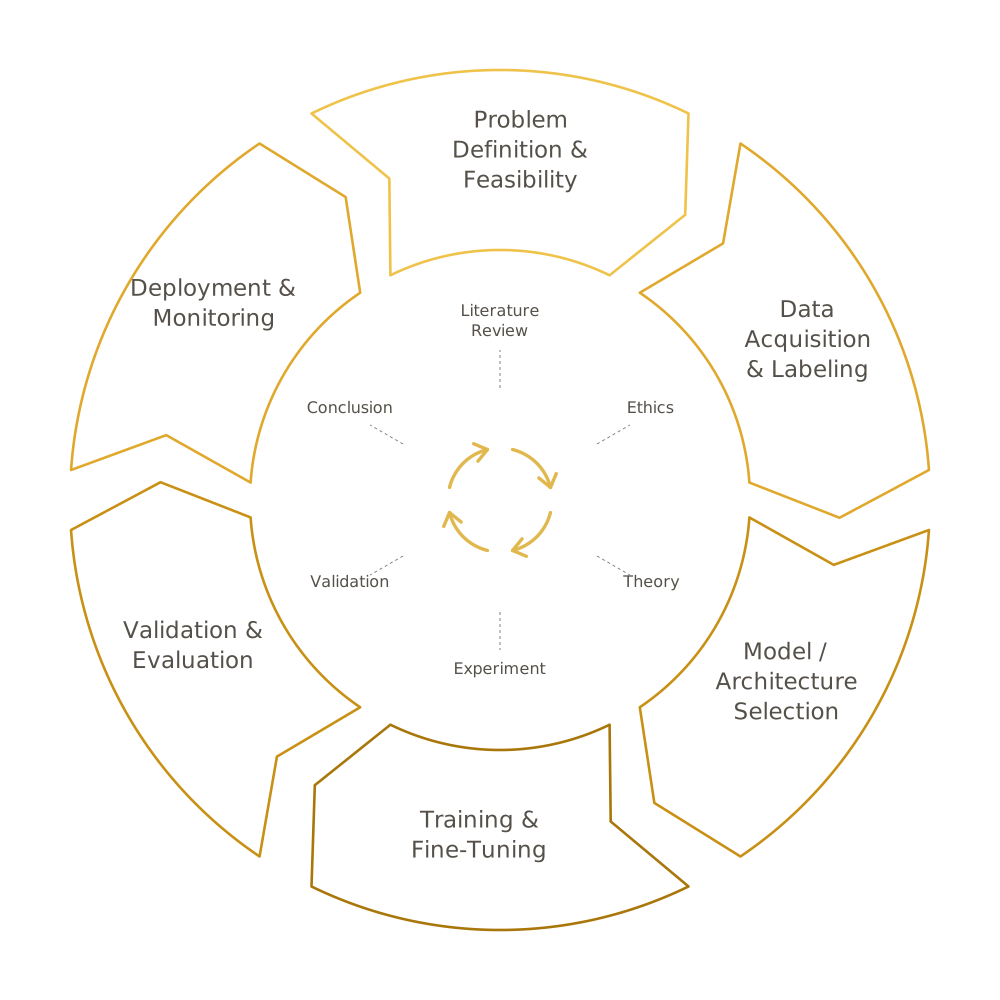
Seventeen modules, 90 ECTS
Tier 1 (15 ECTS)
Module 1 — Introduction to Computer Programming
Covers Python essentials (syntax, data types, control structures) to build a coding foundation for AI and ML. Students practise writing, testing, and debugging programs in realistic scenarios, preparing them for data-driven tasks. Emphasis is on skills used in software development, automation, and data-focused roles.
- Python Fundamentals
- Control Structures
- Realistic Debugging
- AI/ML Foundation
Module 2 — Applied Statistics
Students learn statistical techniques essential for AI and machine learning, including descriptive and inferential methods for analysing data, designing experiments, and validating hypotheses. This module develops competencies in statistical modelling, probability distributions, and hypothesis testing—fundamental skills for training machine learning models, optimising algorithms, and ensuring data-driven decision-making in AI applications.
- Descriptive & Inferential
- Probability Distributions
- Hypothesis Testing
- Experimental Design
Module 3 — Mathematics for Computer Science
Introduces linear algebra, calculus, and probability as core mathematical foundations for AI and machine learning. Students apply vectors, matrices, eigenvalues, and Bayes’ theorem to optimise models and handle uncertainty. These concepts are essential for developing, optimising, and interpreting machine learning algorithms, enabling students to build AI models.
- Linear Algebra
- Probability Theory
- Differential Calculus
- Matrix Operations
Tier 2 (45 ECTS)
Module 4 — Introduction to Artificial Intelligence
Provides a structured overview of AI concepts, techniques and applications, from the history of the field through to current algorithms and their use in robotics, natural language processing and computer vision. Students implement and run AI algorithms on real datasets, assess model accuracy and performance, and distinguish between narrow, general and superintelligent AI. The module also examines the societal and ethical challenges raised by AI systems in practice.
- AI Foundations
- Core Algorithms
- Model Evaluation
- Societal Impact
Module 5 — Introduction to Machine Learning
Covers core ML methods (linear, logistic regression; decision trees; Random Forest), addressing missing data and class imbalance. Students learn model evaluation to build reliable industry solutions for tasks such as customer segmentation, fraud detection, or operational forecasting.
- Regression Techniques
- Tree-Based Methods
- Missing & Imbalanced Data
- Model Evaluation
Module 6 — Numerical Programming in Python
Builds on core Python to work with the numerical libraries that underpin AI and machine learning — NumPy, SciPy and pandas. Students use built-in data structures (lists, dictionaries, sets and tuples) and apply the principles of computational complexity to write efficient, optimised code. Emphasis is on translating mathematical, statistical and scientific concepts into working implementations.
- NumPy & SciPy
- Pandas
- Data Structures
- Optimised Code
Module 7 — Introduction to Deep Learning
Examines neural network fundamentals (gradient descent, backpropagation) along with feedforward, convolutional, and recurrent architectures. Students learn regularisation, hyperparameter tuning, transfer learning, and diffusion models for applications in image analysis, language processing, and beyond.
- Neural Networks
- Backpropagation Techniques
- Activation Functions
- Hyperparameter Tuning
Module 8 — Data Engineering
Covers the processing of data at scale across the full data engineering lifecycle, from ingestion through to warehousing and data modelling. Students write advanced SQL, orchestrate end-to-end ETL pipelines, and work with standard tools including Apache Kafka, Airflow, Spark (PySpark) and the Hadoop ecosystem. Relevant to roles building and maintaining data-intensive applications in cloud environments.
- ETL Pipelines
- Spark & Kafka
- Data Warehousing
- Cloud at Scale
Module 9 — Machine Learning Applications
Applies machine learning techniques to practical problems across sectors including healthcare, finance and marketing. Students implement algorithms in Python, develop and fine-tune models, and evaluate performance across different datasets and metrics. The module examines how feature selection affects results, and the ethical concerns that arise when ML solutions are deployed in industry settings.
- Industry Use Cases
- Model Fine-Tuning
- Feature Selection
- Evaluation Metrics
Module 10 — Predictive Modelling
Develops models that forecast future trends and behaviours from historical data, covering linear and logistic regression, time series analysis, ensemble methods and advanced machine learning techniques. Students build end-to-end predictive solutions, from data collection and preprocessing through to deployment and monitoring, and apply these techniques to new and emerging domains.
- Regression Methods
- Time Series
- Ensemble Methods
- Deployment & Monitoring
Module 11 — Data Visualisation Tools
Covers the industry tools used to turn raw business data into actionable insight, focusing on Tableau and Power BI alongside open-source libraries such as Matplotlib and ggplot2. Students work through the full pipeline — data connection, cleaning and preparation, interactive dashboards, and storytelling with data — using case studies drawn from the finance, retail and supply chain sectors.
- Tableau & Power BI
- Interactive Dashboards
- Data Storytelling
- Sector Case Studies
Module 12 — Ethical Artificial Intelligence Practices
Examines the ethical, legal and social implications of artificial intelligence, including bias in AI algorithms, data privacy, transparency and accountability. Students consider the impact of AI on employment and society, and design solutions that balance innovation with responsibility. The module also develops the ability to lead multidisciplinary teams to ethical standards and to advocate for responsible AI in industry and policy discussions.
- Algorithmic Bias
- Data Privacy
- Transparency & Accountability
- Responsible Deployment
Tier 3 (30 ECTS)
Module 13 — Applied Computer Science Project
This is a 10 ECTS credit, industry-aligned project covering data gathering, model creation, and deployment. Students synthesise skills from prior modules, producing a work-ready portfolio piece that reflects real-world AI challenges and prepares them for end-to-end implementation roles.
- Practical Implementation
- Project Design
- Research Methodology
- Hands-On Experience
Module 14 — Artificial Intelligence Integration Strategies
Focuses on incorporating AI into business and industrial processes, covering deployment methodologies, system interoperability and change management. Students design scalable and sustainable integration solutions, build an AI integration plan for an industry application, and assess the performance of integrated systems. Relevant to roles responsible for moving AI from prototype into operational use.
- System Architecture
- Interoperability
- Change Management
- Integration Planning
Module 15 — Artificial Intelligence for Decision Making
Applies AI to decision support through predictive analytics, decision trees and optimisation algorithms. Students design and implement models for real decision scenarios, assess the quality and reliability of AI-generated recommendations, and use data visualisation to make results interpretable. The module also weighs the ethical considerations of AI-driven decisions and evaluates their effectiveness across different sectors.
- Predictive Analytics
- Optimisation Algorithms
- Decision Support
- Reliability Assessment
Module 16 — Natural Language Processing
Covers the techniques that enable computers to understand, interpret and generate human language, including tokenisation, part-of-speech tagging, named entity recognition, sentiment analysis and advanced NLP models. Students design and deploy complete applications such as chatbots and translation systems, from data collection through to model deployment, and integrate NLP into business analytics tools.
- Text Processing
- Named Entity Recognition
- Sentiment Analysis
- Applied NLP
Module 17 — Prompt Engineering
Covers the design of effective prompts for large language models, from the principles of precise instruction through to techniques that elicit reliable, targeted responses from advanced AI models. Students integrate prompt engineering practices into AI development workflows, optimise prompts collaboratively for multi-faceted projects, and track current research and methods in a fast-moving area.
- Prompt Design
- LLM Behaviour
- Workflow Integration
- Iterative Optimisation
Students may enter the MSc directly or progress from the Postgraduate Diploma in Artificial Intelligence, which covers Tiers 1 and 2.
Ready to apply?
Apply now to start your application, or send us an enquiry and our admissions team will be in touch.
How you'll learn
Fully online, cohort-based, with live teaching and one-to-one support throughout.
Start any month
Monthly starts, no fixed intake. Every student gets an induction at the start covering the platform, the study plan and assessment requirements.
Live classes, recorded
Regular live concept classes with the DSI teaching team, built around practical coding and modelling exercises. Every session is recorded, so you can study around work.
One-to-one tutor support
Individual guidance throughout the programme, with daily live support for questions on material, assessments and progress.
Applied projects
Individual and group work on authentic case studies, leading to the Applied Computer Science Project.
Student community
The DSI Discord channel, where you can raise questions and discuss material with other students and the teaching team.
One platform for everything
Recorded sessions, structured course materials and supplementary resources, available any time.
Internationally accredited
Our accreditation
The Data Science Institute is a full member college of Woolf. Woolf is an accredited, degree - granting Higher Education Institution and is recognised within the European Qualifications Framework (EQF). All diploma and degree programs adhere to rigorous European Standards and Guidelines, ensuring international academic excellence and credibility.

ECTS — the benchmark of excellence
Our curricula are accredited through the European Credit Transfer and Accumulation System (ECTS), a recognised international standard and the world’s largest academic accreditation system. ECTS certification ensures widespread acceptance, facilitating both mobility and career development.

Why it matters
Entry requirements
The programme welcomes applicants from a range of backgrounds and offers two routes: an academic route for those with a suitable qualification, and a non-academic route for candidates with relevant professional experience.
Academic entry route
For applicants with a suitable academic qualification.
- Honours degree
A 2.1 honours degree (or international equivalent) in a numerate or analytical discipline: Mathematics, Statistics, Computer Science, Engineering, Physics, Sciences, Economics or Business Studies with a quantitative focus.
- Alternative qualifications
Alternative qualifications demonstrating sufficient quantitative or analytical skills are also considered.
Non-academic entry route
For candidates with relevant professional experience or non-degree qualifications.
- Professional experience
At least four years of relevant professional experience, recognised as prior learning (RPL).
- Provisional admission
Join the study track with provisional status under performance-based admission (PBA).
- Full admission
Achieve a GPA of 90% or higher in the first two modules.
- Documents
CV, educational certificates and employer references; supplementary registration fees apply.
English language. IELTS 6.5 or higher, or equivalent, for non-native speakers.
How to apply
The application process requires following the steps below, including completing an online form, receiving a conditional offer, registering with Woolf, and finalising admission through document verification and fee payment. Step one takes about ten minutes. You'll need your qualifications, a CV, and — if you're applying through the non-academic route — employer references.
Online application
Begin by completing the online application form on this webpage. Provide all the required information accurately to ensure smooth processing.
Invitation to enrol
Registration with Woolf
Decision
Fee payment
FAQs
What career paths does the MSc in Artificial Intelligence lead to?
The programme covers the skills used in machine learning engineering, AI development, data engineering and AI integration roles, along with the strategic and ethical judgement expected of those leading AI work.
How is the programme structured?
The MSc is 90 ECTS across seventeen modules in three tiers. Tier 1 (15 ECTS) covers programming, applied statistics and mathematics. Tier 2 (45 ECTS) covers artificial intelligence, machine learning, deep learning, data engineering, predictive modelling, data visualisation and ethical AI practice. Tier 3 (30 ECTS) covers the applied project, AI integration strategies, AI for decision making, natural language processing and prompt engineering.
What if I already hold the Postgraduate Diploma in Artificial Intelligence?
The diploma covers Tiers 1 and 2. Progression to the MSc requires the additional 30 ECTS in Tier 3.
What is the applied project?
Module 13 is a 10 ECTS industry-aligned project covering data gathering, model creation and deployment. Students draw on the earlier modules to produce a work-ready portfolio piece reflecting real-world AI challenges.
Do I need programming experience before I start?
No. Module 1 begins with Python essentials, so prior programming experience is not assumed. A numerate or analytical background is expected.
Which tools and languages are used?
Python throughout, with the numerical libraries NumPy, SciPy and pandas. The data engineering module covers advanced SQL along with Apache Kafka, Airflow, Spark and the Hadoop ecosystem. The data visualisation module uses Tableau and Power BI alongside Matplotlib and ggplot2.
How is the programme delivered?
Online. Live instructor-led sessions are combined with self-paced content, one-to-one tutorials, live concept classes and a Discord channel for day-to-day contact with peers and instructors. Recorded sessions and course materials remain available on the learning platform.
What academic qualifications do I need?
A 2.1 honours degree, or international equivalent, in a numerate or analytical discipline. Applicants with alternative qualifications demonstrating sufficient quantitative or analytical skills are also considered.
Can I apply if I do not hold the recommended degree?
Yes. A non-academic entry route is available for candidates with relevant professional experience, and these applications are assessed individually.
What about English language requirements?
English language skills equivalent to IELTS 6.5 or higher are required for non-native speakers.
Is the MSc in Artificial Intelligence accredited?
The Data Science Institute is a full member college of Woolf, an accredited degree-granting higher education institution recognised within the European Qualifications Framework. The programme carries 90 ECTS credits at EQF Level 7.
When can I start?
The programme runs on monthly starts, so you can begin in any month of the year rather than waiting for a fixed intake.
Who can I contact for more information?
Email info@datascienceinstitute.net or call +353 21 204 0519.
Apply for the MSc in Artificial Intelligence
Applications are reviewed on a rolling basis with monthly starts. If you'd rather talk it through first, an admissions advisor can call you.