

Postgraduate Certificate in Data Science
A 30 ECTS foundation programme in data-driven decision-making, covering programming, exploratory data analysis, statistical inference and a focused analytics project. A direct pathway to the Postgraduate Diploma or MSc in Data Science.
- Credits
- 30 ECTS
- Delivery
- Fully online
- Award
- Postgraduate Certificate in Data Science
- Starts
- Monthly
Course Overview
The Postgraduate Certificate in Data Science is a 30 ECTS foundation programme designed for professionals and graduates seeking to build core competencies in data-driven decision-making. It covers programming, exploratory data analysis, statistical inference, and includes a focused analytics project.
Through interactive workshops, real-world case studies, and hands-on exercises, participants learn to interpret and communicate insights from diverse datasets, developing practical skills applicable across industries. The certificate also offers a direct pathway to the Postgraduate Diploma or MSc in Data Science.
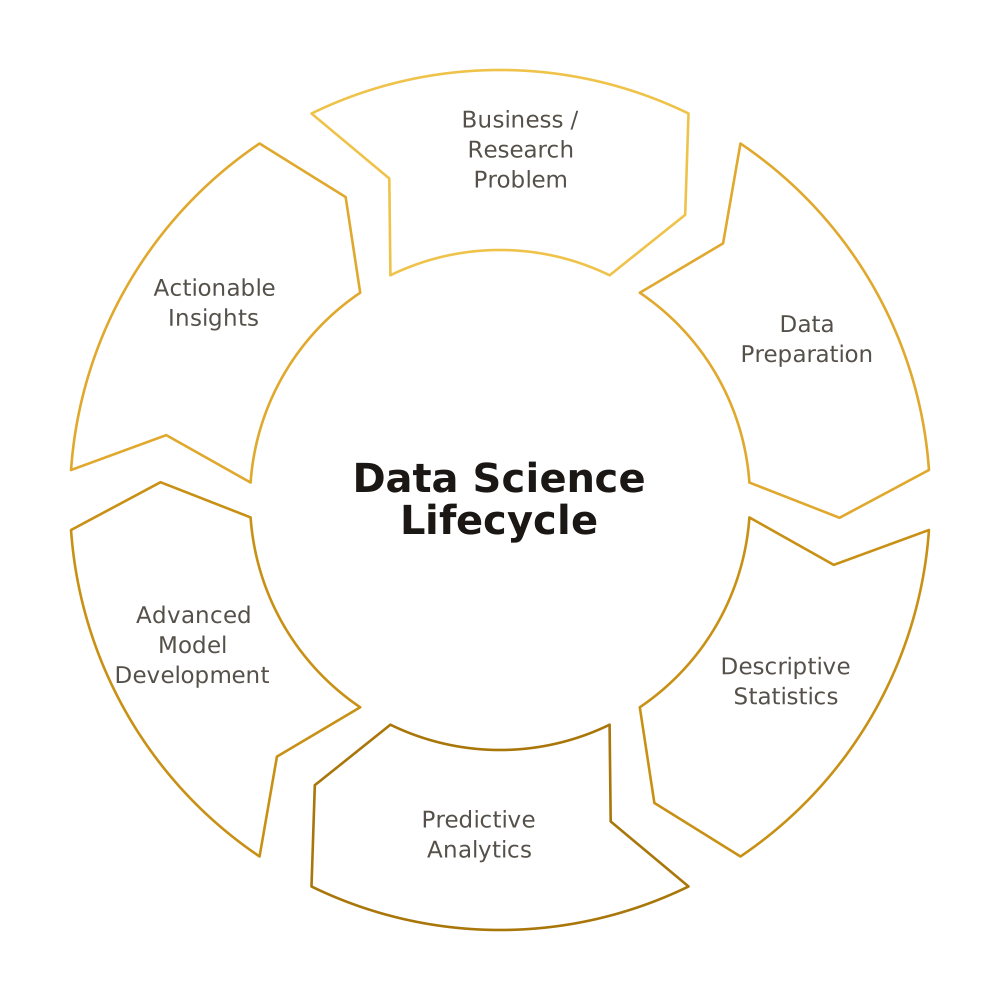
Course modules
Module 1 — Exploratory Data Analysis
Most industry analysis starts with exploratory data analysis and a thorough study of this will help you to perform data health checks and provide initial business insights. You will gain a sound understanding of Python and R programming, descriptive statistics, data management and data visualisation. You will also learn SQL for big data pre-processing and prepare data for big data analytics.
- Programming in Python, R and SQL
- Data management
- Measures of central tendency and variation
- Data visualisation
Module 2 — Statistical Inference
Statistical inference is the process of drawing inferences or conclusions from data using statistical techniques. In this module you will cover sampling, statistical distribution, hypothesis testing, and variance analysis, and use R code to carry out various statistical tests and draw inferences from their output.
- Principles of statistical inference
- Parametric tests
- Non-parametric tests
- Analysis of variance (ANOVA)
Module 3 — Fundamentals of Predictive Modelling
This module introduces predictive modelling and provides a foundation for more advanced methods and machine learning. You'll gain an understanding of the general approach to predictive modelling and then build simple and multiple linear regression models in Python and R and apply these in a range of contexts.
- Predictive modelling principles
- Linear regression models
- Model validation
- Python and R packages for predictive modelling
Module 4 — Advanced Predictive Modelling
In this module you are introduced to model development for categorical dependent variables. Binary dependent variables are encountered in many domains such as risk management, marketing, and clinical research, and this module covers detailed model building processes. Multinomial and ordinal logistic regression are also covered.
- Logistic regression models
- Survival analysis
- Cox regression
- Poisson regression
Module 5 — Data Science in Practice
The Data Science in Practice module provides you with an opportunity to apply your knowledge through project work. You will select a project from a specific domain and appropriately apply exploratory data analysis, statistical methods and select appropriate predictive modelling techniques. This module also develops your scientific communication skills through the preparation of project reports and presentations.
- Presentation and communication skills
- Synthesis of data science knowledge
- Application to real-world data and scenarios
Ready to start
Apply now, or download the brochure to explore the programme in detail.
Delivery
Fully online, cohort-based, with live teaching and one-to-one support throughout.
Start any month
Monthly starts, no fixed intake. Every student gets an induction at the start covering the platform, the study plan and assessment requirements.
Live classes, recorded
Regular live concept classes with the DSI teaching team, built around practical coding and modelling exercises. Every session is recorded, so you can study around work.
One-to-one tutor support
Individual guidance throughout the programme, with daily live support for questions on material, assessments and progress.
Applied projects
Individual and group work on authentic case studies throughout the programme.
Student community
The DSI Discord channel, where you can raise questions and discuss material with other students and the teaching team.
One platform for everything
Recorded sessions, structured course materials and supplementary resources, available any time.
Internationally accredited
Our accreditation
The Data Science Institute is a full member college of Woolf. Woolf is an accredited, degree-granting Higher Education Institution and is recognised within the European Qualifications Framework (EQF). All diploma and degree programmes adhere to rigorous European Standards and Guidelines, ensuring international academic excellence and credibility.

ECTS
Our curricula are accredited through the European Credit Transfer and Accumulation System (ECTS), a recognised international standard and the world's largest academic accreditation system. ECTS certification ensures widespread acceptance, facilitating both mobility and career development.

Why it matters
Qualifications are internationally portable, recognised by employers, institutions and government agencies, and open pathways for further academic progression and career development.
Admission
The programme welcomes applicants from a range of backgrounds and offers two routes: an academic route for those with a suitable qualification, and a non-academic route for candidates with relevant professional experience.
Academic entry route
For applicants with a suitable academic qualification.
- Honours degree
A 2.2 honours degree (or international equivalent) in a numerate or analytical discipline: Mathematics, Statistics, Computer Science, Engineering, Physics, Sciences, Economics or Business Studies with a quantitative focus.
- Alternative qualifications
Alternative qualifications demonstrating sufficient quantitative or analytical skills are also considered.
Non-academic entry route
For candidates with relevant professional experience or non-degree qualifications.
- Professional experience
At least four years of relevant professional experience, recognised as prior learning (RPL).
- Provisional admission
Join the study track with provisional status under performance-based admission (PBA).
- Full admission
Achieve a GPA of 90% or higher in the first two modules.
- Documents
CV, educational certificates and employer references; supplementary registration fees apply.
English language. IELTS 6.5 or higher, or equivalent, for non-native speakers.
Admissions
Complete the online application form, receive an invitation to enrol, register with Woolf, and finalise your admission through document verification and fee payment. Step one takes about ten minutes. You'll need your qualifications, a CV, and — if you're applying through the non-academic route — employer references.
Online application
Submit your application online with your qualifications and background.
Invitation to enrol
Suitable applicants are invited to enrol on the programme.
Registration
Register with Woolf, DSI's accrediting Higher Education Institution.
Decision
Your application is reviewed and a decision confirmed.
Fee payment
Complete fee payment to secure your place.
Questions
What are some potential job roles or career pathways after completing the Postgraduate Certificate (PGC) in Data Science?
The certificate builds the core skills used in data-driven decision-making across industries: programming, exploratory data analysis, statistical inference and predictive modelling. It is also a direct pathway to the Postgraduate Diploma or MSc in Data Science for those aiming at more advanced roles.
Does this course offer upskilling opportunities for professionals already in the field?
Yes. The certificate is designed for professionals as well as graduates who want to build core competencies in data-driven decision-making, and every live class is recorded so you can study around work.
How is the Postgraduate Certificate in Data Science delivered?
Fully online, with monthly starts. Every student has an induction covering the learning platform, the study plan and the assessment requirements, followed by regular live concept classes with the DSI teaching team (all recorded), one-to-one tutor support and the DSI Discord channel for contact with other students and the teaching team.
What kind of assessments or projects are involved?
Applied work throughout: individual and group work on authentic case studies and realistic data problems, including a focused analytics project, with support from the teaching team. The assessment requirements are covered at your induction.
Is the Postgraduate Certificate in Data Science accredited or recognised?
The Data Science Institute is a full member college of Woolf, an accredited degree-granting higher education institution recognised within the European Qualifications Framework. The programme carries 30 ECTS credits at EQF Level 7.
Are the credits transferable to other programmes?
The 30 ECTS credits count toward the Postgraduate Diploma and MSc in Data Science, which the certificate leads to directly. ECTS is the European standard for credit transfer; recognition by another institution is at that institution’s discretion.
What kind of certificate will I receive upon completion?
The Postgraduate Certificate in Data Science, a 30 ECTS award at EQF Level 7.
What are the academic entry requirements?
A 2.2 honours degree, or international equivalent, in a numerate or analytical discipline such as Mathematics, Statistics, Computer Science, Engineering, Physics or the Sciences, or Economics or Business Studies with a quantitative focus. Alternative qualifications demonstrating sufficient quantitative or analytical skills are also considered.
What if my degree is not in a numerate or analytical discipline?
Alternative qualifications demonstrating sufficient quantitative or analytical skills are also considered. Candidates with relevant professional experience can also apply through the non-academic entry route.
Can I still apply if I do not meet the minimum degree requirement or lack a formal degree?
Yes, through the non-academic entry route. It requires at least four years of relevant professional experience, recognised as prior learning. You join with provisional status and move to full admission by achieving a GPA of 90% or higher in the first two modules. Alternative qualifications demonstrating sufficient quantitative or analytical skills are also considered on the academic route.
What about English language requirements?
English language skills equivalent to IELTS 6.5 or higher are required for non-native speakers.
How do I apply for the programme?
Complete the online application form, which takes about ten minutes. Suitable applicants are invited to enrol, register with Woolf, DSI’s accrediting higher education institution, and secure their place through document verification and fee payment.
What supporting documents are typically required?
Your qualifications and a CV. Applicants on the non-academic route also provide educational certificates and employer references. Non-native English speakers need evidence of IELTS 6.5 or equivalent.
When can I start the programme?
The programme runs on monthly starts, so you can begin in any month of the year rather than waiting for a fixed intake.
Apply for the Postgraduate Certificate in Data Science
Applications are reviewed on a rolling basis with monthly starts. If you'd rather talk it through first, an admissions advisor can call you.