

Postgraduate Diploma in Computer Science (AI & ML)
Build deep technical skills in AI and machine learning across eleven modules, from programming and mathematics to deep learning and MLOps. Progress to the MSc with a 40 ECTS top-up.
- Duration
- 12 months part time
- Next Intake
- September 2026
- Fees
- Up to 100% funding in Ireland
- Exams
- 60 ECTS credits


Springboard+ is co-funded by the Government of Ireland and the European Union. Please see www.EUFunds.ie for further details
Course Overview
The Postgraduate Diploma in Computer Science (Artificial Intelligence and Machine Learning) is a 60 ECTS programme that develops advanced skills in AI development and deployment. Covering key areas such as Python programming, foundation models, computer vision, NLP, and high-dimensional data analysis, the programme blends theoretical foundations with applied projects.
Students gain practical experience through live coding, workshops, and case studies, preparing them to design and maintain AI-driven systems. The programme also provides a progression pathway to the MSc in Computer Science (AI & ML), through a 40 ECTS top-up.
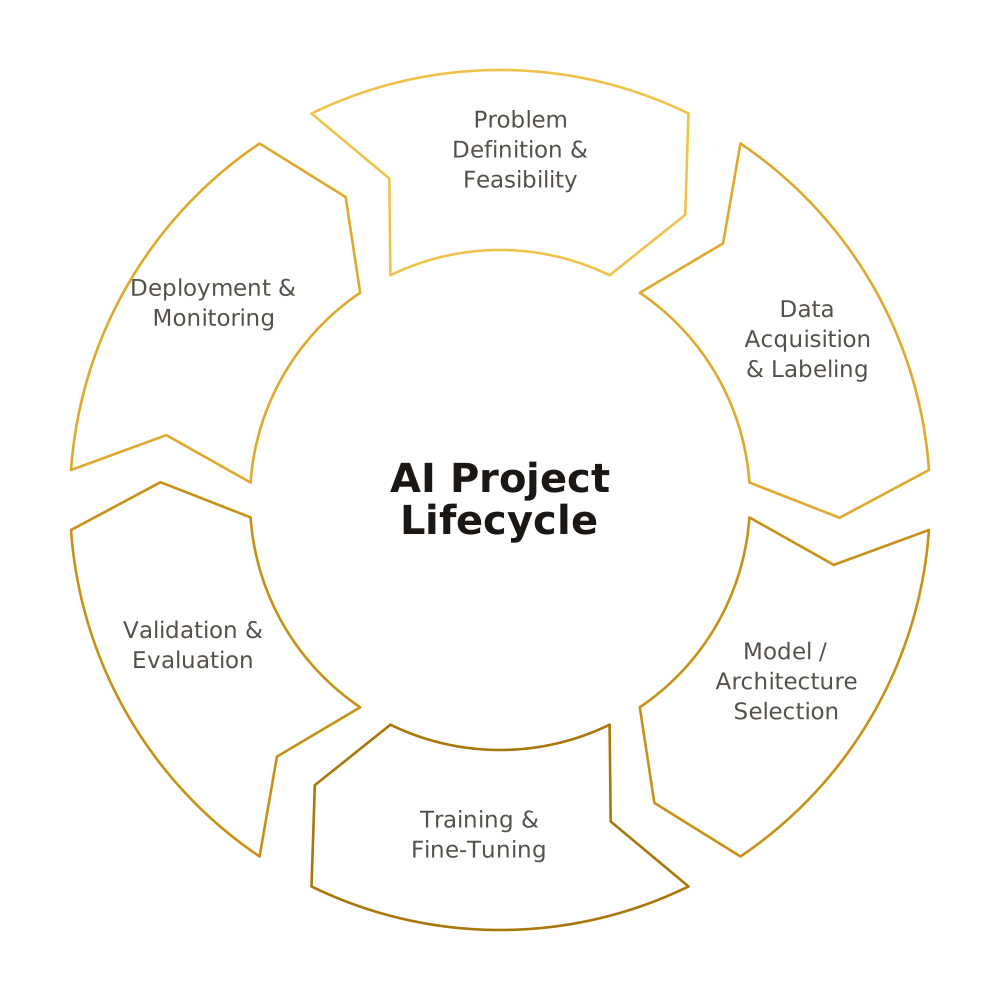
Eleven modules, 60 ECTS
Module 1 — Introduction to Computer Programming
Covers Python essentials (syntax, data types, control structures) to build a coding foundation for AI and ML. Students practice writing, testing, and debugging programs in realistic scenarios, preparing them for data-driven tasks. Emphasis is on skills used in software development, automation, and data-focused roles.
- Python Fundamentals
- Control Structures
- Realistic Debugging
- AI/ML Foundation
Module 2 — Applied Statistics
Students learn statistical techniques essential for AI and machine learning, including descriptive and inferential methods for analysing data, designing experiments, and validating hypotheses. This module develops competencies in statistical modeling, probability distributions, and hypothesis testing — fundamental skills for training machine learning models, optimising algorithms, and ensuring data-driven decision-making in AI applications.
- Descriptive & Inferential
- Probability Distributions
- Hypothesis Testing
- Experimental Design
Module 3 — Mathematics for Computer Science
Introduces linear algebra, calculus, and probability as core mathematical foundations for AI and machine learning. Students apply vectors, matrices, eigenvalues, and Bayes' theorem to optimise models and handle uncertainty. These concepts are essential for developing, optimising, and interpreting machine learning algorithms, enabling students to build AI models.
- Linear Algebra
- Probability Theory
- Differential Calculus
- Matrix Operations
Module 4 — Introduction to Machine Learning
Covers core ML methods (linear, logistic regression; decision trees; Random Forest), addressing missing data and class imbalance. Students learn model evaluation to build reliable industry solutions for tasks such as customer segmentation, fraud detection, or operational forecasting.
- Regression Techniques
- Tree-Based Methods
- Missing & Imbalanced Data
- Model Evaluation
Module 5 — High Dimensional Data Analysis
Addresses complex datasets via dimensionality reduction (PCA, t-SNE), clustering (K-Means, DBSCAN), and feature selection (Lasso). Students learn to manage large feature spaces — essential in fields like finance, genomics, and text analytics — uncovering insights and streamlining computations.
- Dimensionality Reduction
- Feature Selection
- Data Visualisation
- Scalable Processing
Module 6 — Advanced Machine Learning
Explores boosting (AdaBoost, XGBoost, LightGBM) and AutoML for efficient model experimentation. Students apply SHAP and LIME for interpretability, aligning AI solutions with ethical considerations and compliance requirements in regulated industries.
- Boosting Techniques
- AutoML Efficiency
- Model Interpretability
- Ethical Compliance
Module 7 — Introduction to Deep Learning
Examines neural network fundamentals (gradient descent, backpropagation) along with feedforward, convolutional, and recurrent architectures. Students learn regularisation, hyperparameter tuning, transfer learning, and diffusion models for applications in image analysis, language processing, and beyond.
- Neural Networks
- Backpropagation Techniques
- Activation Functions
- Hyperparameter Tuning
Module 8 — Deep Learning for Computer Vision
Focuses on convolutional networks for classification, detection, segmentation, and examines vision transformers and diffusion models for generative tasks. Students learn to handle visual data at scale, relevant to sectors like healthcare imaging, security, and autonomous systems.
- Image Processing
- Object Detection
- Convolutional Nets
- Feature Extraction
Module 9 — Deep Learning for Natural Language Processing
Covers deep learning for text: embeddings (Word2Vec, GloVe), recurrent architectures (LSTM, GRU), and transformer-based models (BERT, GPT). Also explores diffusion-based language models and retrieval-augmented generation (RAG) for tasks like sentiment analysis, NER, translation, and conversational AI.
- Word embeddings
- Recurrent architectures
- Transformer models
- Retrieval-augmented generation
Module 10 — Productionisation of Machine Learning Systems
Focuses on deploying and maintaining ML applications in professional environments. Students use containerisation (Docker), API development (FastAPI, Flask), and MLOps practices for continuous integration, monitoring, and iterative improvement of AI solutions.
- Continuous Integration
- Deployment Pipelines
- Version Control
- Monitoring Models
Module 11 — Applied Computer Science Project (AI & Machine Learning)
This is a 10 ECTS credit, industry-aligned project covering data gathering, model creation, and deployment. Students synthesise skills from prior modules, producing a work-ready portfolio piece that reflects real-world AI challenges and prepares them for end-to-end implementation roles.
- Practical Implementation
- Project Design
- Research Methodology
- Hands-On Experience
Progress to the MSc in Computer Science (AI & ML) by adding DevOps (5 ECTS), Foundations of Cloud Computing (5 ECTS) and the Advanced Applied Computer Science dissertation (30 ECTS).
Ready to apply?
Apply now, or download the brochure to explore the programme in detail.
How you'll learn
Fully online, cohort-based, with live teaching and one-to-one support throughout.
Start any month
Monthly starts, no fixed intake. Every student gets an induction at the start covering the platform, the study plan and assessment requirements.
Live classes, recorded
Regular live concept classes with the DSI teaching team, built around practical coding and modelling exercises. Every session is recorded, so you can study around work.
One-to-one tutor support
Individual guidance throughout the programme, with daily live support for questions on material, assessments and progress.
Applied projects
Individual and group work on authentic case studies, leading to the Applied Computer Science Project.
Student community
The DSI Discord channel, where you can raise questions and discuss material with other students and the teaching team.
One platform for everything
Recorded sessions, structured course materials and supplementary resources, available any time.
Internationally accredited
Our accreditation
The Data Science Institute is a full member college of Woolf. Woolf is an accredited, degree-granting Higher Education Institution and is recognised within the European Qualifications Framework (EQF). All diploma and degree programmes adhere to rigorous European Standards and Guidelines, ensuring international academic excellence and credibility.

ECTS — the benchmark of excellence
Our curricula are accredited through the European Credit Transfer and Accumulation System (ECTS), a recognised international standard and the world's largest academic accreditation system. ECTS certification ensures widespread acceptance, facilitating both mobility and career development.

Why it matters
Qualifications are internationally portable, recognised by employers, institutions and government agencies, and open pathways for further academic progression and career development.
Entry requirements
The programme welcomes applicants from a range of backgrounds and offers two routes: an academic route for those with a suitable qualification, and a non-academic route for candidates with relevant professional experience.
Academic entry route
For applicants with a suitable academic qualification.
- Honours degree
A 2.1 honours degree (or international equivalent) in a numerate or analytical discipline: Mathematics, Statistics, Computer Science, Engineering, Physics, Sciences, Economics or Business Studies with a quantitative focus.
- Alternative qualifications
Alternative qualifications demonstrating sufficient quantitative or analytical skills are also considered.
Non-academic entry route
For candidates with relevant professional experience or non-degree qualifications.
- Professional experience
At least four years of relevant professional experience, recognised as prior learning (RPL).
- Provisional admission
Join the study track with provisional status under performance-based admission (PBA).
- Full admission
Achieve a GPA of 90% or higher in the first two modules.
- Documents
CV, educational certificates and employer references; supplementary registration fees apply.
English language. IELTS 6.5 or higher, or equivalent, for non-native speakers.
How to apply
Complete the online application form, receive an invitation to enrol, register with Woolf, and finalise your admission through document verification and fee payment. Step one takes about ten minutes. You'll need your qualifications, a CV, and — if you're applying through the non-academic route — employer references.
Online application
Submit your application online with your qualifications and background.
Invitation to enrol
Suitable applicants are invited to enrol on the programme.
Registration
Register with Woolf, DSI's accrediting Higher Education Institution.
Decision
Your application is reviewed and a decision confirmed.
Fee payment
Complete fee payment to secure your place.
FAQs
What are some potential roles or career pathways after completing this Postgraduate Diploma?
The programme develops the skills used to design, deploy and maintain AI-driven systems, across Python programming, foundation models, computer vision, natural language processing and high-dimensional data analysis.
Does this diploma support upskilling for professionals already working in tech?
Yes. Study is part-time and designed around working professionals, with a structured weekly rhythm, and every live class is recorded.
How is the Postgraduate Diploma in Computer Science (AI & ML) structured and delivered?
Eleven modules, 60 ECTS: programming, applied statistics and mathematics, then machine learning, high-dimensional data analysis, deep learning for computer vision and NLP, and productionisation of machine learning systems, ending with the Applied Computer Science Project. Delivery is fully online and part-time over 8 to 12 months, with monthly starts.
What does a typical schedule look like, and how is support provided?
Part-time study with a structured weekly rhythm. Live online lectures with faculty are recorded so you can revisit them, and support comes from one-to-one tutorials, live academic support every working day and the DSI Discord channel.
Are there group projects or individual assessments?
Both. You work individually and in groups on authentic case studies, including collaborative project work with peers across sectors, leading to the Applied Computer Science Project.
Is the Postgraduate Diploma accredited or recognised?
The Data Science Institute is a full member college of Woolf, an accredited degree-granting higher education institution recognised within the European Qualifications Framework. The programme carries 60 ECTS credits at EQF Level 7.
Can these credits be applied toward further study?
Yes. The diploma is a progression route to the MSc in Computer Science (AI & ML). ECTS is the European standard for credit transfer; recognition by another institution is at that institution’s discretion.
Can I progress to the MSc in Computer Science?
Yes. Modules 1 to 10 are the same in both programmes, so you top up to the MSc by completing DevOps (5 ECTS), Foundations of Cloud Computing (5 ECTS) and the Advanced Applied Computer Science dissertation (30 ECTS).
What academic qualifications do I need?
A 2.1 honours degree, or international equivalent, in a numerate or analytical discipline such as Mathematics, Statistics, Computer Science, Engineering, Physics or the Sciences, or Economics or Business Studies with a quantitative focus. Alternative qualifications demonstrating sufficient quantitative or analytical skills are also considered.
Is there an alternate entry route if I don't have the recommended qualifications?
Yes, through the non-academic entry route. It requires at least four years of relevant professional experience, recognised as prior learning. You join with provisional status and move to full admission by achieving a GPA of 90% or higher in the first two modules. Alternative qualifications demonstrating sufficient quantitative or analytical skills are also considered on the academic route.
What about English language requirements?
English language skills equivalent to IELTS 6.5 or higher are required for non-native speakers.
How do I apply for the programme?
Complete the online application form, which takes about ten minutes. Suitable applicants are invited to enrol, register with Woolf, DSI’s accrediting higher education institution, and secure their place through document verification and fee payment.
Who can I contact for more information?
Email info@datascienceinstitute.net or call +353 21 204 0519.